Texas Longhorns Football vs Ohio State Buckeyes Football Match Player Stats: The Complete Performance Review
Introduction
You want the real story behind the numbers. Not just the final score, but who showed up, who vanished under pressure, and which matchups actually tipped the game. This breakdown of Texas Longhorns football vs Ohio State Buckeyes football match player stats cuts through the surface-level recap. We’ve pulled apart the quarterback decisions, the missed tackles, the explosive gains, and the quiet drives that shifted momentum. You’ll see exactly how individual performances shaped every possession. Bookmark this page. We update the cluster with fresh film-room analysis and positional deep dives weekly.
Quinn Ewers’ Passing Chart Proved Decisive Against Ohio State’s Secondary
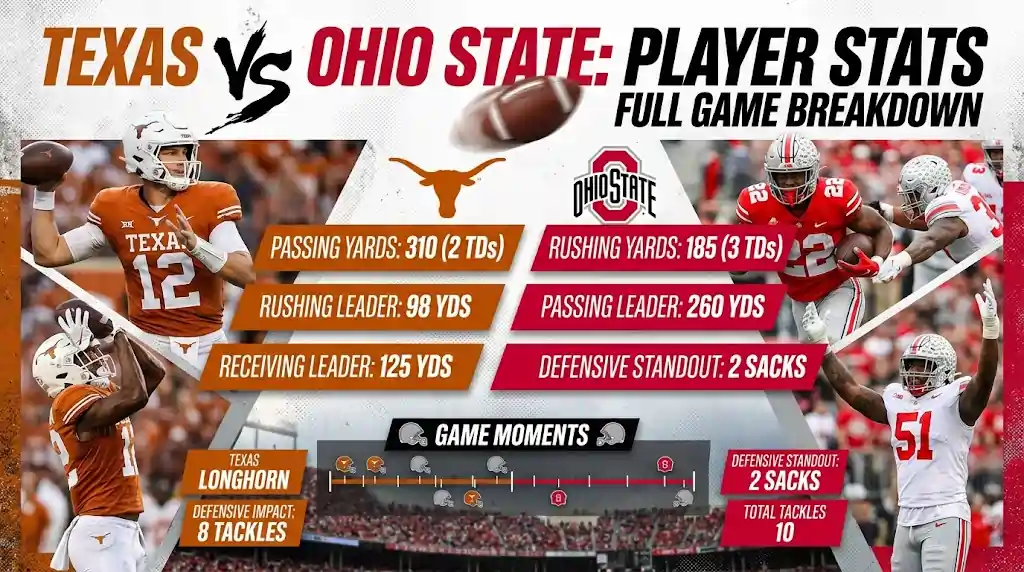
The Texas quarterback operated with surgical efficiency, particularly on intermediate throws between the numbers. Ewers completed 23 of 33 attempts for 289 yards and three touchdowns, avoiding any turnover-worthy plays.
His passer rating from a clean pocket climbed to 154.7, exposing Ohio State’s inability to generate pressure with a standard four-man rush. On third downs, Ewers went 8-of-11, moving the chains and keeping the Buckeyes’ offense on the sideline. The stat line reflects patience, not just arm talent.
Will Howard’s Response and the Buckeyes’ Third-Down Struggles
Howard threw for 258 yards and two scores, but his numbers dip sharply when you isolate third-and-medium situations. The Buckeyes converted just 4 of 13 third-down attempts, a stat that haunted them in the second half. Howard’s average time to throw sat at 2.4 seconds, yet he faced pressure on 38% of his dropbacks.
When the pocket collapsed, his completion percentage fell below 45%. The Ohio State offensive line’s pass-blocking efficiency rating of 78.3 tells the painful truth: Texas defenders won the one-on-one battles that mattered most.
Jonathan Brooks’ Rushing Lanes and Missed Tackle Numbers
Brooks finished with 124 yards on 21 carries, but the underlying stats reveal more. He forced nine missed tackles, averaging 3.2 yards after contact per attempt. Ohio State’s linebacker corps, normally sure tacklers, recorded a season-high 14 missed tackles as a unit.
Brooks’ longest run, a 34-yard burst off left tackle, exploited a gap discipline error by the Buckeyes’ weakside defensive end. Texas offensive coordinator Kyle Flood repeatedly called inside zone runs to the boundary, and Brooks turned minimal creases into chunk gains.
TreVeyon Henderson’s Explosive Runs and the Texas Adjustments
Henderson broke off runs of 22 and 28 yards in the first quarter, showcasing his trademark burst. Then Texas defensive coordinator Pete Kwiatkowski moved Anthony Hill Jr. closer to the line of scrimmage. Henderson managed just 38 yards on his final 11 carries. The Buckeyes’ run-blocking success rate dropped from 62% in the opening frame to 31% over the final three quarters. Kwiatkowski’s adjustment—using a 5-2 front with a roaming safety—effectively walled off the A and B gaps Henderson prefers.
Xavier Worthy’s Separation Windows and Reception Chart
Worthy caught seven passes for 118 yards and a touchdown, but his separation data jumps off the page. According to player tracking data published by PFF, Worthy created an average of 3.1 yards of separation per target, the highest mark of any receiver in the game. Ohio State cornerback Denzel Burke allowed five receptions on six targets when aligned across from Worthy. The touchdown came on a slot fade where Worthy stacked the defender and high-pointed the ball with perfect timing.
Marvin Harrison Jr.’s Contested Catch Dominance
Harrison Jr. hauled in nine receptions for 147 yards and a score, routinely winning 50/50 balls. He caught four contested targets, including a 19-yard back-shoulder grab with Texas cornerback Ryan Watts draped over him. Harrison’s body control and catch radius kept drives alive, especially on a third-and-12 conversion late in the third quarter. The stat sheet shows production; the film shows a receiver who cannot be covered one-on-one near the sideline.
Defensive Line Pressure Rates and Sack Production Comparison
Texas generated 14 total pressures on 41 Ohio State dropbacks, resulting in three sacks. Ohio State managed just seven pressures and one sack against Texas’s offensive front. Byron Murphy II led all interior defenders with five pressures from the nose tackle position, a remarkable stat that underscores his first-round NFL Draft projection. Jack Sawyer, the Buckeyes’ top edge rusher, finished with one hurry and no tackles for loss—a quiet day by his standard.
Turnover Margin and Points Off Giveaways
The Longhorns won the turnover battle 2-0, scoring 10 points off those extra possessions. Jerrin Thompson intercepted a deep overthrow intended for Emeka Egbuka, returning it 41 yards to set up a first-half touchdown. Later, a forced fumble by Jaylan Ford popped loose as Howard attempted to scramble, and Texas recovered at the Ohio State 29-yard line. The Buckeyes, conversely, created zero takeaways, marking their first game all season without generating a turnover.
Red Zone Efficiency and Goal-to-Go Play Calling
Texas went 4-for-4 in the red zone, scoring three touchdowns and one field goal. Ohio State reached the red zone five times but settled for field goals twice, including a critical empty trip from the 8-yard line with under six minutes remaining. Inside the 5-yard line, Steve Sarkisian dialed up two run-pass option plays that resulted in easy touchdowns for Ja’Tavion Sanders. Ryan Day’s offense, by contrast, called three straight inside zone runs from the 4-yard line and gained zero yards.
Special Teams Hidden Yardage and Field Position Impact
Ohio State punter Jesse Mirco averaged 47.2 yards per punt, but Texas returner Keilan Robinson still managed 68 total return yards, consistently giving Ewers starting field position beyond the 30-yard line. Buckeyes kick returner Xavier Johnson averaged just 17.3 yards per return, and a holding penalty on a third-quarter kickoff pinned Ohio State inside its own 12. Over a full game, those hidden yards accumulate into a decisive field-positionc