The True Edelweiss Meaning: A Star of the Alps
Introduction
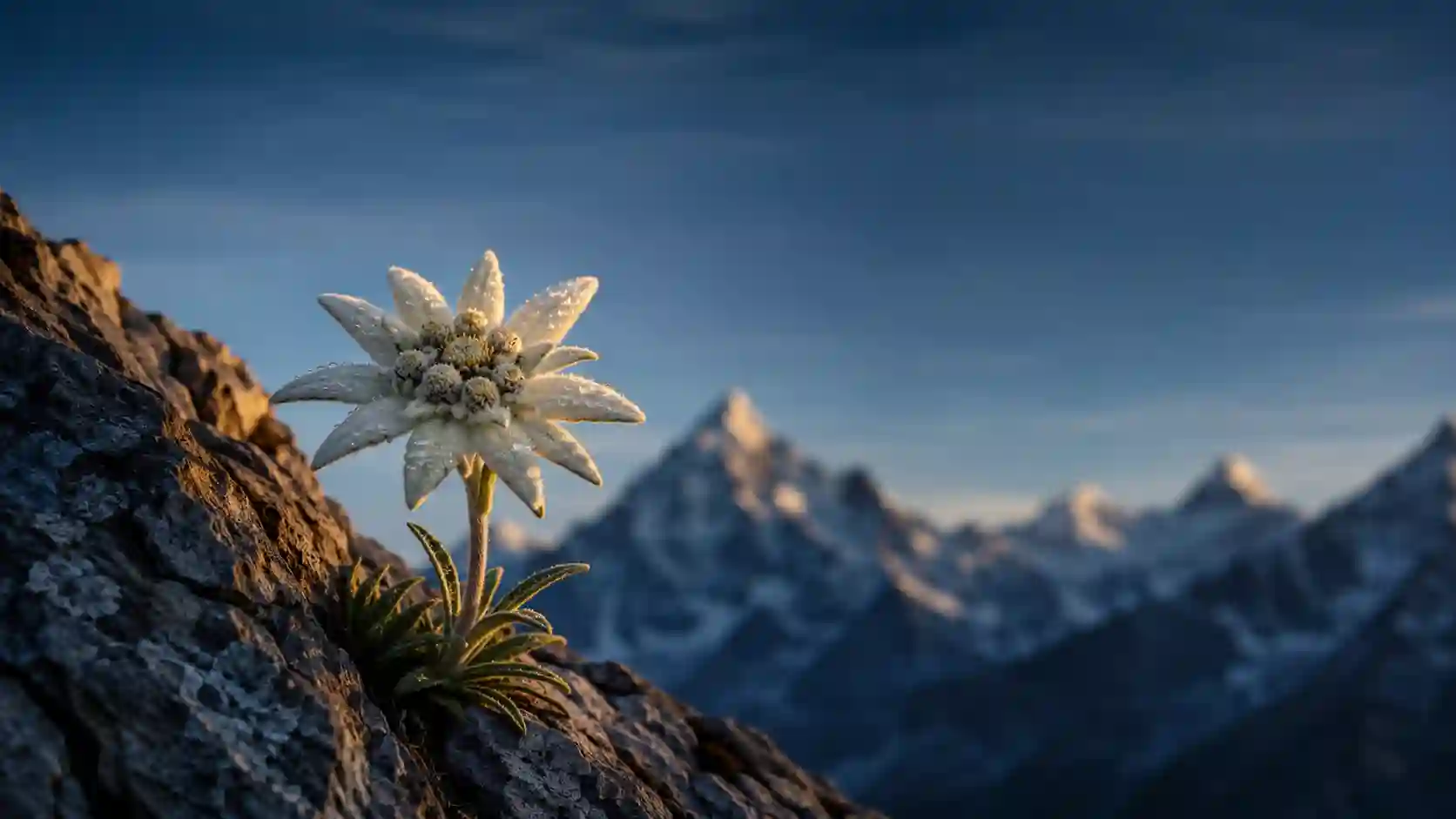
You spot a woolly, star-shaped flower clinging to a jagged rock face at extreme altitude, and you instinctively know it’s special. That immediate feeling captures the heart of the real edelweiss meaning. Forget generic floral definitions; this plant represents a daring proof of love, a national emblem of rugged pride, and a testament to survival against thin air and freezing winds. This guide cuts through the noise to give you the authentic story behind the bloom, exploring its linguistic roots, dangerous harvesting traditions, and why it strictly demands our protection today.
Table: Edelweiss at a Glance
| Feature | Description |
| Scientific Name | Leontopodium nivale |
| Literal Meaning | “Noble White” (German) |
| Family | Asteraceae (Daisy/Sunflower family) |
| Primary Symbolism | Deep devotion, courage, alpine purity |
| Native Habitat | Rocky limestone Alpine regions (1,800–3,000 meters) |
| Protection Status | Strictly protected in most Alpine nations |
10+ Informational H2 Titles
What is the Literal Edelweiss Meaning in Language?
Breaking down the word provides immediate clarity. The name doesn’t originate from English but from German. “Edel” translates directly to “noble,” and “weiß” means “white.” Therefore, the most direct edelweiss meaning is simply “noble white.” This naming highlights the flower’s pristine, bright appearance against the stark, grey mountain terrain. Scientists later reinforced this notion of royalty by classifying it under the genus Leontopodium, which stems from the Greek words “leon” (lion) and “podion” (foot). The fuzzy, lobed shape of the leaves and the flower head’s felt-like texture apparently reminded the botanist of a lion’s paw.
The Deep Symbolism of Edelweiss: Why It Represents Devotion
Why do people associate this small bloom with intense love and dedication? The symbolism isn’t accidental; it comes directly from the life-risking act of picking one. During the 19th century, a romantic custom developed among young men in the Alps. To prove their sincerity and bravery to a sweetheart, a man would climb treacherous precipices to harvest a star from the steep cliff faces. Returning with the woolly flower became a physical receipt of his willingness to face death for his beloved. Consequently, the core edelweiss meaning transformed into a nonverbal message: “You are worth risking everything for.”
The Edelweiss Meaning as a Military Badge of Honor
Beyond romance, the flower holds a gritty military history. During World War I and II, the edelweiss meaning shifted from a lover’s token to a badge of elite status. The flower decorated the lapels of specialized mountain infantry units, most famously the German Gebirgsjäger and the Austro-Hungarian Alpine troops. Wearing the metal or cloth badge signified that a soldier was not just a fighter but an expert mountaineer possessing extreme endurance, courage, and the ability to operate in brutal high-altitude conditions. To this day, several European alpine military units retain the iconic flower as their cap badge, honoring this legacy of grit rather than the political regimes they once served.
Is the Edelweiss Meaning Tied to Swiss National Identity?
Absolutely. While the plant grows across the entire Alpine arc—spanning Austria, France, Italy, and Slovenia—Switzerland has most effectively adopted it as a national symbol. In Swiss culture, the flower represents the nation’s rugged independence, purity, and direct democracy. You see it not just in meadows but heavily commercialized on chocolate boxes, airliner tails (Swiss International Air Lines), and the five-franc coin. However, this deep cultural appropriation has created a fascinating paradox. Marketing teams use the flower to sell a sanitized Swiss experience, yet simultaneously, strict Swiss laws protect the wild plant from being picked by tourists seeking an authentic piece of that identity.
The Botanical Reality Behind the “Flower”
Botany often surprises romantics. The iconic white “petals” that form the perfect star shape are not petals at all. These are specialized bracts—modified leaves covered in thick, white, woolly hairs. The actual flowers sit in a dense, small, yellowish cluster in the very center of these velvety rays. This felt-like covering (trichomes) serves a precise evolutionary purpose, not an aesthetic one. It functions as a protective mechanism, shielding the plant’s reproductive core from the high doses of ultraviolet radiation and the drying winds found at high altitudes. The star shape itself is nature’s perfect billboard, highly visible to pollinating flies in the sparse alpine landscape.
Edelweiss Meaning in Traditional Folk Medicine
Long before it became a tourist symbol, mountain communities defined the edelweiss meaning through practical survival medicine. Pastoralists and farmers couldn’t afford to ignore a plant so hardy. They brewed the boiled roots and aerial parts into a bitter tea—often called “bellyache tea”—to treat dysentery and severe abdominal pain. Externally, they mixed the plant with milk and honey to create a thick paste applied to skin infections and wounds. Modern photochemical research confirms the plant contains bisabolane sesquiterpenes and lignans that exhibit antimicrobial and anti-inflammatory properties, validating the ancient practice of using it as a topical remedy for skin irritations.
Why Is the Edelweiss Meaning Now Linked to Conservation?
This is the most critical modern shift in the flower’s story. The unchecked Victorian and early 20th-century craze for picking the flower as a souvenir nearly drove it to regional extinction. Tourists tore up roots, and climbers greedily collected bouquets. Today, the most powerful edelweiss meaning is synonymous with strict conservation. As early as 1878, Switzerland implemented the first nationwide prohibition on harvesting the flower. It is now a fully protected species in Austria, Germany, and large parts of Italy. Picking a wild specimen can land you with a hefty fine exceeding €5,000. The flower currently acts as a flagship species for protecting the fragile, warming Alpine ecosystem against climate change and human trampling.
Edelweiss in Skincare: Science Over Romance
Modern cosmetic chemistry has redefined the plant’s value proposition. Laboratories cultivate specific strains of edelweiss in controlled valleys to avoid depleting wild stocks. Scientists extract a potent antioxidant compound called leontopodic acid from the cell cultures. Research indicates that this specific acid provides strong resistance to oxidative stress, potentially slowing the breakdown of collagen fibers in human skin. By neutralizing free radicals more effectively than many common antioxidants, the ingredient defends against fine lines and environmental damage. Consequently, the luxury skincare industry now markets edelweiss stem cell extract not just for its branding, but for peer-reviewed, measurable dermatological efficacy.
Debunking Myths About the Edelweiss Meaning
Let’s clear the air regarding common fabrications. First, the edelweiss meaning is not “loneliness.” While it grows in remote spots, its primary cultural narrative always celebrated brave connection, not solitude. Second, the song Edelweiss from The Sound of Music is not a Nazi anthem nor an old Austrian folk song. Richard Rodgers and Oscar Hammerstein II composed it purely for the Broadway musical in 1959. It’s an original piece about patriotic Austrian spirit written by two Americans. Finally, while incredibly tough, the flower is not immortal. It requires specific limestone soil pH and cannot simply grow anywhere. The very specific habitat needs make its survival precarious.
How to Grow the “Noble White” Responsibly
You can honor the symbolism without poaching. Growing edelweiss in your home garden requires mimicking alpine deprivation. You must use extremely gritty, alkaline, well-draining soil—think crushed limestone and coarse sand mixed with very little organic matter. The plant despises wet feet and rich compost. Full sun is mandatory, but high heat is the enemy; it thrives in cool summers. When you purchase seeds or starts from a reputable nursery, you support horticultural cultivation rather than wild theft. Growing it yourself grounds the true edelweiss meaning in patience, revealing firsthand just how special this survivor of the high crags really is.
Edelweiss Meaning in Modern Literature and Film
Art consistently reframes nature. In the 1965 film The Sound of Music, Captain von Trapp’s solo performance of “Edelweiss” reframed the flower as a quiet, dignified protest against the Nazi annexation of Austria. The song uses the bloom’s purity as a metaphor for the country’s soul. In Mark Sebanc’s epic fantasy series The Stoneholding, a rare white star-flower functions as a pivotal symbol of inherited right and resistance against dark forces, clearly drawing direct inspiration from alpine lore. These modern narratives strip away the tourist kitsch and restore a heavy, almost sacred weight to the flower, using it as shorthand for a homeland worth fighting for.
Frequently Asked Questions About Edelweiss Meaning
What is the hidden meaning of edelweiss?
The most profound hidden meaning ties directly to a love test. Because the flower grows exclusively in precarious, rocky spots near mountain peaks, picking one historically meant a young man risked falling to prove his love. The hidden message wasn’t just “I love you,” but specifically “I will climb where no one else dares to prove my devotion.” This act physically demonstrated a promise to face any danger for the relationship.
Does the edelweiss meaning differ between Germany and Switzerland?
While the baseline symbol of rugged alpine life stays constant, national emphasis varies. In Switzerland, it functions as a standardized, heavily marketed national brand for tourism, banking, and quality. In Germany, the flower ties more closely to Bavarian regional identity and the specific martial legacy of the mountain troops. Austrians view it as a non-partisan symbol of the state’s natural beauty and republican defense forces.
Why is edelweiss a symbol of bravery?
The terrain defines the trait. Edelweiss typically grows at altitudes between 2,000 and 3,000 meters on exposed limestone crags. Reaching a specimen required technical climbing over loose scree and sheer drops long before modern safety gear existed. For a soldier, pinning the flower to a cap indicated they possessed the specialized skills to fight and survive in vertical warfare. It’s a botanic badge of extreme physical courage.
If I come across edelweiss in the wild, can I pluck it?
No. In practically every Alpine country, the wild Leontopodium species receives strict legal protection. Fines for picking or uprooting a single wild flower can range from significant financial penalties to imprisonment, depending on the local conservation laws. It is categorized as a protected flora in Annex I of the Bern Convention. The strict rule stands: take only photos, never pick the physical plant.
Does edelweiss really heal wounds?
Yes, within a traditional context and confirmed by modern science. Alpine folk medicine consistently used edelweiss poultices to speed up the healing of cuts and rashes. A 2014 research paper in the Journal of Ethnopharmacology demonstrated that extracts from the plant exhibit significant antimicrobial and anti-inflammatory activity, justifying its centuries-long use as a vulnerary remedy for skin ailments.
What does the bract structure tell us about the edelweiss meaning?
The star-shaped bracts clarify the flower’s survival strategy. The white, felt-like wool minimizes water evaporation and blocks damaging UV light. The symmetrical star geometry increases the plant’s visibility to scarce mountain pollinators. Botanically, the form defines the function; the beauty we interpret as “noble” is actually a sophisticated suit of armor for surviving one of Earth’s most hostile habitats.
Conclusion
You now understand that the true edelweiss meaning isn’t just a fact to memorize—it’s a narrative of extreme altitude, human bravery, and fragile survival. Let this star-shaped bloom remind you that the most beautiful things often require the strongest protection. If this guide changed your perspective on alpine wildflowers, share it with someone who still thinks it’s just a song lyric. Look for cultivated seeds next spring, grow your own piece of alpine resilience, and leave the wild ones standing proud where they belong. Your respect for its meaning starts with a choice to protect it.